GCSE Geography
This summary provides a brief overview of the AQA GCSE Geography course to help you understand what you will be studying, how you will be assessed, and potential future pathways.
The AQA GCSE Geography course is split into three main papers, covering a balance of physical and human geography, and the interaction between them.
Paper 1: Living with the physical environment
- The challenge of natural hazards: Studying tectonic hazards (earthquakes, volcanoes) and extreme weather (tropical storms, droughts, climate change).
- Physical landscapes in the UK: Focusing on two distinct environments—either coastal landscapes and river landscapes—to understand their formation and management.
- The living world: Studying ecosystems, with a focus on tropical rainforests and hot deserts, looking at the impact of human development on these environments.
Paper 2: Challenges in the human environment
- Urban issues and challenges: Investigating a major city in the UK and a city in a Newly Emerging Economy (NEE) or Low Income Country (LIC), focusing on issues like housing, transport, and sustainability.
- The changing economic world: Looking at global variations in development, the role of transnational corporations (TNCs), and how economic change is managed, including a study of a UK-based economic landscape.
- The challenge of resource management: Examining the global distribution and security of food, water, and energy resources, with an in-depth focus on one of these resources (e.g., global food security).
Paper 3: Geographical applications
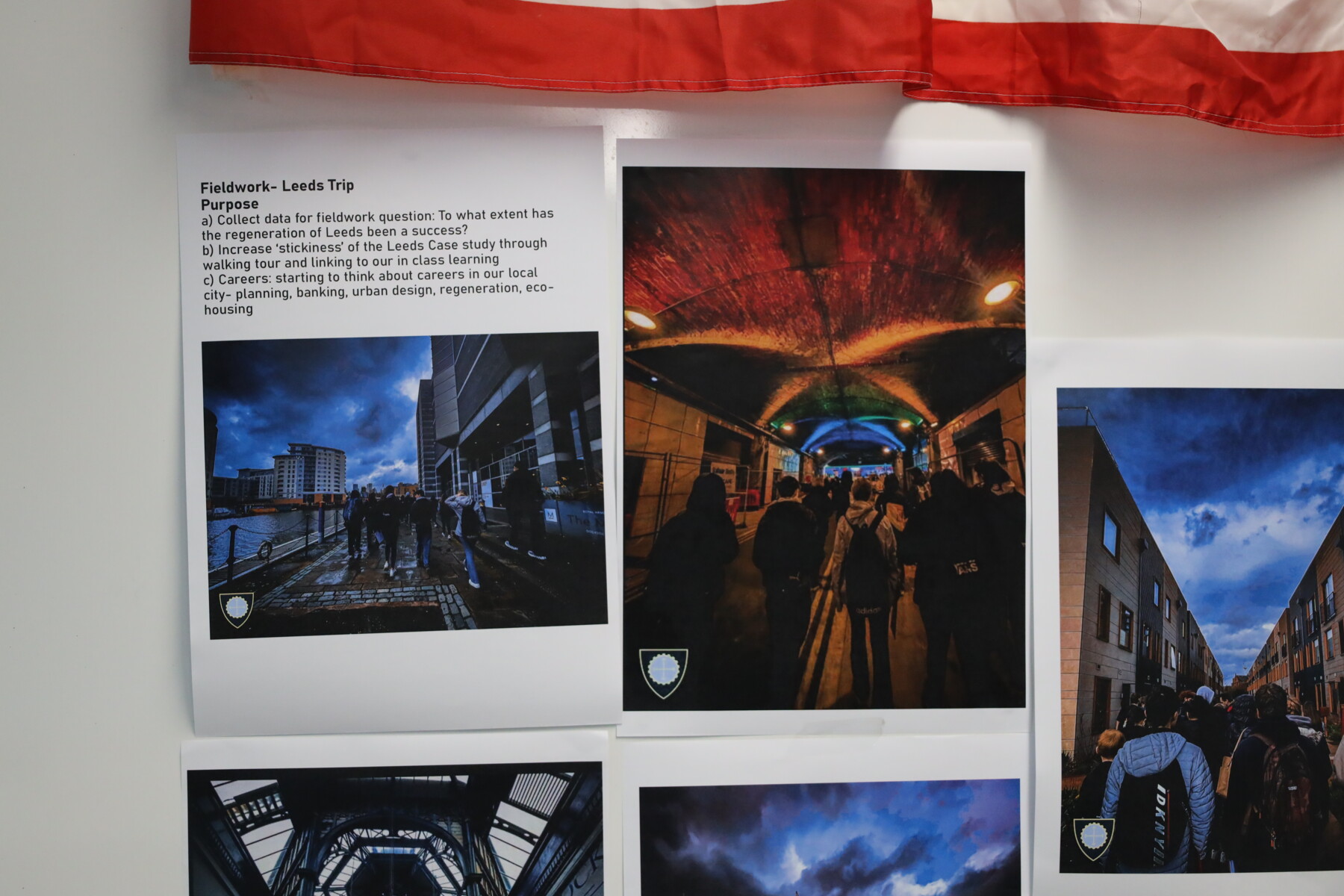
This paper draws on all topics and includes an assessment based on two compulsory fieldwork enquiries (one physical and one human). Students will be tested on their geographical skills, data analysis, and interpretation.
The GCSE is assessed entirely by three written exams at the end of Year 11. There is no coursework (Non-Examined Assessment - NEA).
| Paper | Content | Duration | Weighting |
| Paper 1 | Physical Geography | 1 hour 30 minutes | 35% |
| Paper 2 | Human Geography | 1 hour 30 minutes | 35% |
| Paper 3 | Geographical Applications (Issues & Fieldwork) | 1 hour | 30% |
The exams test a range of skills, including describing, explaining, analysing data, evaluating, and extended writing (e.g., 9-mark questions).
Geography is highly valued by universities and employers because it equips students with a diverse and sought-after skill set. A GCSE in Geography supports a wide range of A Level and career options, including:
- Environmental & Planning: Environmental consulting, conservation, hydrology, urban and rural planning, renewable energy.
- Data & Analysis: Data science, Geographic Information Systems (GIS) mapping, market research, surveying.
- Business & Development: Logistics, international development, aid work, tourism management.
- Government & Public Sector: Civil Service, teaching, public health, disaster management.
Geography bridges the arts and sciences, teaching students to think critically and analytically about complex global issues, which is excellent preparation for any future path.
Useful Websites
There are a number of useful online resources which we would encourage students to use
https://www.coolgeography.co.uk – Lots of lovely videos and some PowerPoints and explanations on key content
https://www.physicsandmathstutor.com/geography-revision/gcse-aqa/ For past papers, revision notes and summaries
https://www.bbc.co.uk/bitesize/examspecs/zy3ptyc For an all-round look at the course including multichoice quizzing